Writing Program

Writing has been an integral part of the Hoffman Center for the Arts from its earliest days. 

We welcome writers of all interests and skill levels to be a part of our diverse and thriving community.  Our programming includes writing workshops, author readings and presentations, publications, an annual poetry contest, and opportunities for creative expression and inspiration.

*Open Write*   Come Write In!  2nd Sundays from 2-4pm in the Writing Room with hosts, Emily Ransdell & Marcia Silver

For any level of experience, Open Write is an open invitation to practice the craft of writing in community with fun, generative prompts.  On each 2nd Sunday of the month, we will gather in the Writing Room at HCA and write to a variety of prompts in an informal setting with optional time to share writing without critique or instruction.  

Upcoming dates for Open Write 2026:   January 11, February 8, March 8, April 12, May 10, June 14
(Open Write will take a Summer break in July, August, and September.)
Bring your favorite writing materials or laptop.  No registration required; donations welcome.


Author Presentations


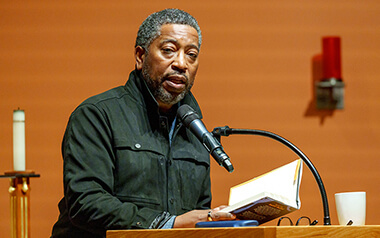
The Writing Program is pleased to present author readings, book signings, and workshops throughout the year as part of our Manzanita Writers Series to inspire and connect our community to the practice of writing.  We invite local, regional, and nationally-known authors in a variety of genres to present their work for literary events open to the public.  To view upcoming authors, events, and workshops, please check the HCA calendar and sign up for the HCA newsletter as we add events throughout the year.


Neahkahnie Mountain Poetry Prize

The 2026 Neahkahnie Mountain Poetry Prize

Every January, we encourage poets with connections to the North Oregon Coast to submit work for this contest between January 15 – February 15 through the HCA Submittable page.  The 2026 submission window is now closed and judging is complete for this year’s contest.  Winning poets are announced below.

For 2026, the first-place winner receives $250, the second-place winner receives $100, the third-place winner receives $50, and their winning poems receive publication on the Hoffman Center for the Arts website.

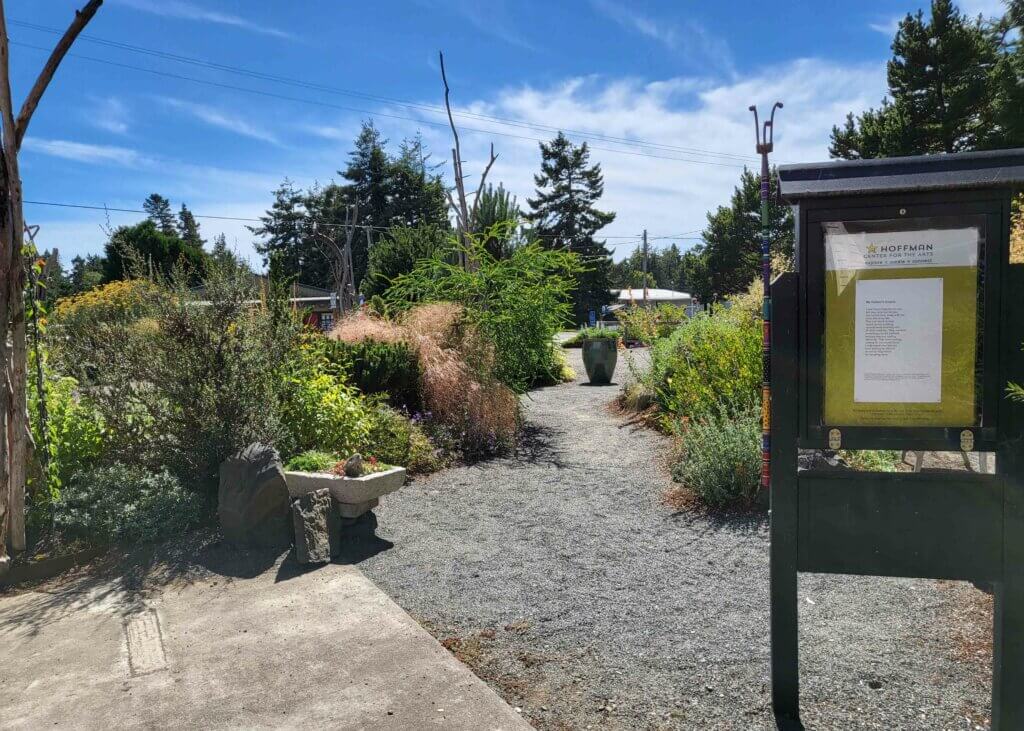
Poems receiving an Honorable Mention will be on display in a monthly rotation on our Poetry Post, located in the HCA Wonder Garden on Laneda Avenue.

All poets with placed poems in 1st, 2nd, and 3rd places and poets receiving honorable mention are invited to read their poems at the Hoffman Center for the Arts during the Poetry Event with Airlie Press on Sunday, April 12th, 2026, during which we will celebrate National Poetry Month and the launch of new poetry collections from Airlie Press.

The contest judge for 2026 is David Pickering.

David J.S. Pickering is a native of Tillamook County.  His first poetry collection, Jesus Comes to Me as Judy Garland, received the Airlie Prize in 2020. Three of his poems have been nominated for the Pushcart Prize, though David will tell you that “close only counts in a game of horseshoes.” His poetry is published (or forthcoming) in a variety of journals including Relief: A Journal of Art and Faith, Passager, Tar River Poetry, Mantis, Fireweed, Lips, Reed Magazine, and Gertrude.

Please direct any questions to [email protected]

In the Woods

1.

Is there a difference between the woods and me,
between rainstorm and laughter, bark and skin,
this flickering light and the beating of my heart?

There are things I can touch, things that touch me;
in their reflecting echo is where I find myself lost.
Follow the crooked path down—I’ll be here.

2.

The forest knows me:
passing shadow, fallen branch,
dandelion, bending.

I recall: lightfall
that cast me, storm that loosed me,
wind that lifts me, seeding.

Stump to ridge: detail
and scope, exceeding the grasp
of an old hand, reaching.

3.

Light embraces stone. Stone creates shadow.
Shadow shelters rain. Water holds the light.

Everything I see moves in a circle,
never around me, or because of me.

Down the crooked path, this is where I’ll be.

– – –

Steve Quinn is a retired college professor and instructional designer who lives with his wife, Ann, on two soggy acres along the Oregon Coast. He has been writing for as long as he can remember. During his years of teaching, he wrote textbooks and journal articles, patiently honing the bad habits of academic writing. In 2022 he earned his MFA in creative writing from Pacific University, which inspired him to start on a new collection of rejection letters. Since retiring to the coast, Steve and Ann have planted over 250 trees on their property, Steve continues to write and share fiction and memoir as well as poetry, and he maintains an active correspondence with their 13-year-old granddaughter in Washington DC, who also is a writer. Steve is grateful anytime he can help something spread its roots and stand on its own.
 
– – –
 
Of Steve’s winning poem, here is what our judge, David Pickering, had to say:

“This well-crafted work asks a question in the first stanza and then muses on it for the remainder of the poem. The language is spare and visual with a cinematic quality, a moving camera-eye providing images and details that accrete meaning and move the poem along. The speaker in the poem provides intermittent grounding and context without being intrusive or explaining a lot. This poem invites the reader ‘down the crooked path’ and into a woods where light, stone, shadow, and water move in a circle ‘never around me, or because of me,’ a woods where being lost actually brings the lucky reader home.”
 

Within Reach
A ‘found’ poem excerpted from Demon Copperhead by Barbara Kingsolver

I could hear the cackly gossip of some
crows outside, making their deals
on the roof somewhere.

A rope swing dangled above the roar,
suggesting happier times where this was a place
to swim. Now you wouldn’t wish it on your dirty clothes.

The clouds bellied up since morning;
the crows scrubbing the reachable branch off their tree.

Hundreds of people passed by outside
hugging their coats around them,
looking at their feet, walking fast.

Maybe because it was Sunday, with the Godly
in church–on butt-polished wood benches and
colored glass windows like jigsaw puzzles
of people and sheep–and the rest sleeping off their sins.

The only words we had between us now
were the foreplay to fighting.

Love has to come from
a strong place, not just
grabbing whatever’s in reach.

Whatever I love about you I get
to live with. And the other stuff,
I live with that too.

– – –

Susan Eliot is a collage artist who also loves to ‘collage’ poems from the literature she reads in what some call “found poems”.  Retirement two years ago has allowed her me become a permanent resident of Gearhart, a sweet and quiet community that nurtures Susan’s soul.

– – –

A Landscape No Longer Mine

1

Six months before we moved, I gazed
from my upstairs window through the tunnel
of trees to the beach two blocks away,
sky and water white with morning haze.

We say, “In the fullness of time,” such-and-such
will happen. We will leave when the time
is right, I thought, as though leaving
had nothing to do with me.

All those years I walked, carefree,
to the beach, then north or south, I knew
the path could shrink. I didn’t know
how hard the ground would be.

2

As I walk the path to the birch tree
behind our Portland home, the ground softens
underfoot, becomes the trail through dune grass
from Ocean Road onto Manzanita Beach.

A dry stream bed of river rock turns
into wet shoreline. Bark dust in the azalea beds
into wave prints—beach cusps—at ocean’s edge.
A neighbor’s fence-top into the far horizon.

– – –

Phyllis Mannan recently moved to Beaverton from Manzanita, Oregon. She has published a poetry chapbook, Bitterbrush (Finishing Line Press). Her poems have appeared in Cirque, Cloudbank, North Coast Squid, The Oregonian, Willawaw Journal, and elsewhere. Work is forthcoming in the anthology Campfire Stories: The Oregon Coast by Mountaineers Books.

– – –

These poems will be on display on a monthly rotation in the Wonder Garden from May-September, 2026.

“Preparing for Surgery” by Kiersta Fricke-Gostnell
“Remission: The First Outpatient Procedure” by Asher Finch
“Fur Breakfast” by Willa Schneberg
“Eulogy for M. Lagerfeld” by Merridawn Duckler
“equinox” by Deborah Akers

David J.S. Pickering is thrilled that his poem has received the Neah-Kah-Nie Mountain Prize. He is a native of Tillamook County, born at Rinehart Hospital in Wheeler though he will demur when asked in what year. David was raised in Rockaway, and he is a proud graduate of Neah-Kah-Nie High School (Go Pirates!). His first poetry collection, Jesus Comes to Me as Judy Garland, received the Airlie Prize in 2020. Three of his poems have been nominated for the Pushcart Prize, though David will tell you that “close only counts in a game of horseshoes.” His poetry is published (or forthcoming) in a variety of journals including Relief: A Journal of Art and Faith, Passager, Tar River Poetry, Mantis, Fireweed, Lips, Reed Magazine, and Gertrude. David lives with his husband in Portland Oregon where, even as you read this, he has likely had too much coffee.

Carey Taylor, this year’s contest judge, had these comments about David’s winning poem:  “Beginning with the title the poet immediately lets the reader know this is a poem about more than buying a home. In ten stanzas of well crafted couplets using clear imagery, humor, reflection and memory the speaker in this poem takes the reader on a journey that travels both place and time only to arrive where all of us ultimately arrive— in our own imagined last place and time”.

Closing on the Last Home

A mid-century unit. Good light and no stairs. A bar
to grab in the shower. A pool. Like me, it needs a lot

of cosmetic lifts, but days slip so quickly through
the calendar grid, and I can’t keep up, so I don’t care

much about looking updated (though I can still put
together an outfit). I’ve got old-man cash, so high

interest didn’t faze me though I remain interested
in the forward-spinning world but it no longer

belongs to me and I’m cranky about that which
has made me the cliché I thought my dad was

walking around saying things like Kids today have
no damn work ethic. Sad, but I’ve had it coming. So

let’s get back to the condo: a cantilevered balcony
overlooks the ocean, and I stand here like a Gabor

accessorized with a fluffy poodle. I’ve become
soft-hearted in my tough-minded atomic age,

loving this splendid place and reminding myself
it’ll be my last. It’s like acquiring a headstone

designed by Mr. Eichler. The last home I’ll buy.
A light-filled place to live. A stylish place to die.


Aladdin Stanley Thermos, Quart Size, with Carrying Handle

I stood up at my father’s church funeral—the one he specifically

asked us not to haveaggrieved by the minister’s dependence
on Jesus to fill in for his lack of knowledge of the man
in ashes before him.

I carried Dad’s beat up, sage-green thermos with me, it more
my father than the velvet-bagged box of dust and bone. 
Rough and tumble, always dependable.  He was everything,
and nothing much.
I plunked the thermos down on the pulpit, looked out, saw sorrow
like small birds fluffed up to face the chill night ahead. I sang out.
He’s here, deep in this vacuum flask.
He’s here, in this coffee-stained cup.

At 4 a.m., driving empty roads to the log mill, the genie asked
my father what he wished for—more sleep, less pain—
and gave him hot coffee, the warmth easing the ache 
in his back where, as yet unknown, cancer bit into bone. 

I wanted that thermos, totem of my father.
His second wife—never one to get up early to fill it
with four scoops of Taster’s Choice and boiling water—kept it.  
She is dying of emphysema now, and I can’t find the breath
to speak her name.

After a long career flying for a major airline, Kitt Patten is now staying put in one time zone. Writing poetry gives her a new way to look at the world, and in turn, she learns about who she is and where she’s been.

Ravens Tumbling

They lifted on thermals.
Not gently, but thrust upward
as though a god-wind blew hard
into the drinking-glass clear sky,
and the flakes or bits of them
erupted out of its top.

They paused there, commas
between clauses of exhilaration 
and dark expectation.
After that wing-tucked half second 
the pair unfurled, cockeyed,
and fell turning on both axes,
discarding any cartesian calculus
in the chaos of their freefall.

I felt as I imagined they must, 
as if all was lost,
but without it mattering—
to any of us—whether or not
they saved themselves
at the end of the sentence;
In their waiting they had already 
inhabited both possibilities.

Logan Garner lives and writes in Warrenton, Oregon at the mouth of the Columbia River. He writes with a sense of place and reverence for nature and strives to capture small moments and memories in the context of their larger landscapes, both natural and figurative.

“Changes” by Ruby Hansen Murray
“Song for the Body” by Phyllis Mannan
“Grace” by Kitt Patten
“Rhode Island Reds” by Kitt Patten
“The first year without” by Asher Finch

Astoria Poet Florence Sage is current MC and a regular reader at the monthly Ric’s Poetry Mic in Astoria, a poetry event presenter, and recent poetry columnist for HIPFiSH Monthly. For 25 years she was a founding production crew member for the annual Fisher Poets Gathering in Astoria.
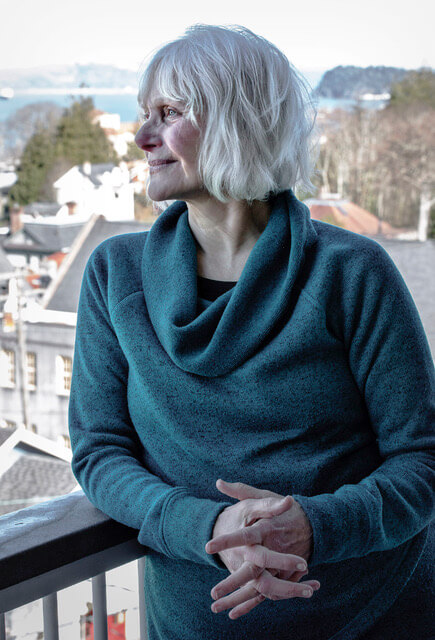
Sage has two Master’s degrees and has been an award-winning daily newspaper feature writer-editor in Montana, an Oregon-licensed counselor, and most recently a social sciences and philosophy college teacher. As a poet, she has been the subject of several stage and radio interviews and feature articles in the region.

Losses have given her an interest in the physics of change. 

Her full-length poetry collections are: Nevertheless: Poems from the Gray Area (2014); The Man Who Whistled, The Woman Who Wished: A Polish-Canadian Story (2021); What to Do with Night: Poems (2023). All are at RiverSea Gallery, Godfather’s and Time Enough Books, and in Astoria and Warrenton libraries.

Photo Credit: David Lee Meyers

The contest judge, Logan Garner, commented “The collection of images in this piece, both elegy and love poem, hold up entropy as a mirror (or perhaps an explanation) for loss, aging and loneliness—topics we tend to avoid, yet which are unavoidable.  At once fatalistic and grateful for the present, Goodbye reminds us that, in spite of the inevitable—whether we can truly prepare for it or not—we are yet part of a greater, magnificent whole, just enough comfort to bear it all. I read this poem on a loop for several minutes, just for it not to come to and end. But, as the narrator so beautifully teaches, it must.”

Goodbye

The Second Law of Thermodynamics

Not solid after all, the rings of Saturn,
but gasses and dispersing
under the law of loss
to someday leave the planet bare
while already giant Titan speeds away
from all the other moons, oh Saturn.

Even Earth can’t hold our moon for good
as it inches each year from our grasp
until our only nighttime company is gone
and anyway the moon is shrinking now,
the surface caving in, as faces do,
buckling and crumpling into dips and crags
until the contours disappear
that give us the man in the moon.

But long before physics dismembers the sky
to leave Earth lonely in the dark
you will lose me
and I will lose you
no matter how much we try
so kiss me goodbye every night
while we can.

Stillicide

Little Frida Magdalena Carmen,
            How preciously you paint on uneven legs
            dabbling so sweetly with spider monkeys and parrots

Playing out your bloody fantasies,
            the pink of your painkillers, the orange of overdose,
            the leg amputations and gangrenous toes

How darling, adorable of you
            to trace La Llorona, murderer of children.
            For, of failed abortions and miscarriages
            How much can you know?

Of a pelvis impaled by a handrail of iron,
            Of corsets fashioned from plaster and steel?
            You, satin ribbon wrapped round a bomb,

You, dove chained in marriage to an elephant,
            whose night trysts with your sister bring
            children to dandle on your knee

Delicate mestiza flower,
            What can you know of art, trapped there behind an easel
            strapped to your bed in La Casa Azul?

Where you peer in that mirror,
            at a life lived while dying,
            dipping brushes into peasant clothing—
            huipils, rebozos and Aztecan legends

Paint with your own eyes and nothing more, my dearest darling
            Sketch skeletons and black angels to watch
            from the length of your four-poster bed

Use paint as a pain killer, oh precious one.
            And when you are gone, we will bury you sweetly
            beneath a girlish flag of communist red

Marianne Monson is the author of twelve books for children and adults, with an emphasis on frontier-era women’s history. Marianne holds an MFA in Creative Writing from Vermont College of Fine Arts is founder of a literary nonprofit, The Writer’s Guild, and writes from a 100-year-old house in Astoria, Oregon.


Crocodile Rock

I remember when —
I remember when I was twelve
And danced with Dan
In my Grandmother’s basement

To Elton
Over and over
Plucking the needle off the vinyl
And oh-so-lightly nestling the sharp point back in the groove

We constructed hot-wheel race tracks
And played pool
And thought we had discovered the
Magic of music

I lost touch with Dan when
My family moved to Arizona
A thorny desert
And decades later, when I tracked him down

His confused grammar and jumbled stories
Of manic fixations and desperate lows
Were so different and strange
And not the boy I remembered

That I stepped away
And when he sent a card saying he
Was running for president
I sent him a twenty dollar bill

Garth Upshaw lived in Portland for 37 years and Astoria/Warrenton is where he spends much of his vacation time. His sister-in-law lives in Warrenton, and a dear artist friend lives in Astoria. He feels a strong connection to the river and the ocean and loves camping in Fort Stevens.

Connie Soper, “The Language of Solitude”
Karen Keltz, “Studying War”

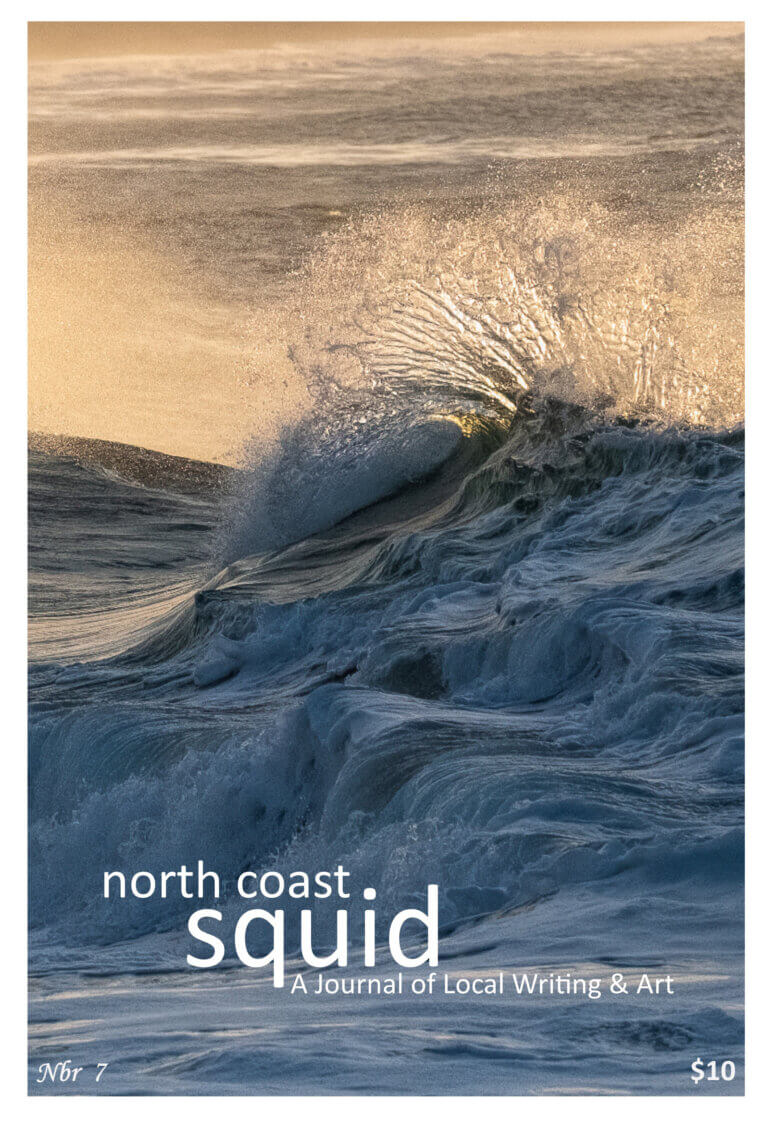
North Coast Squid

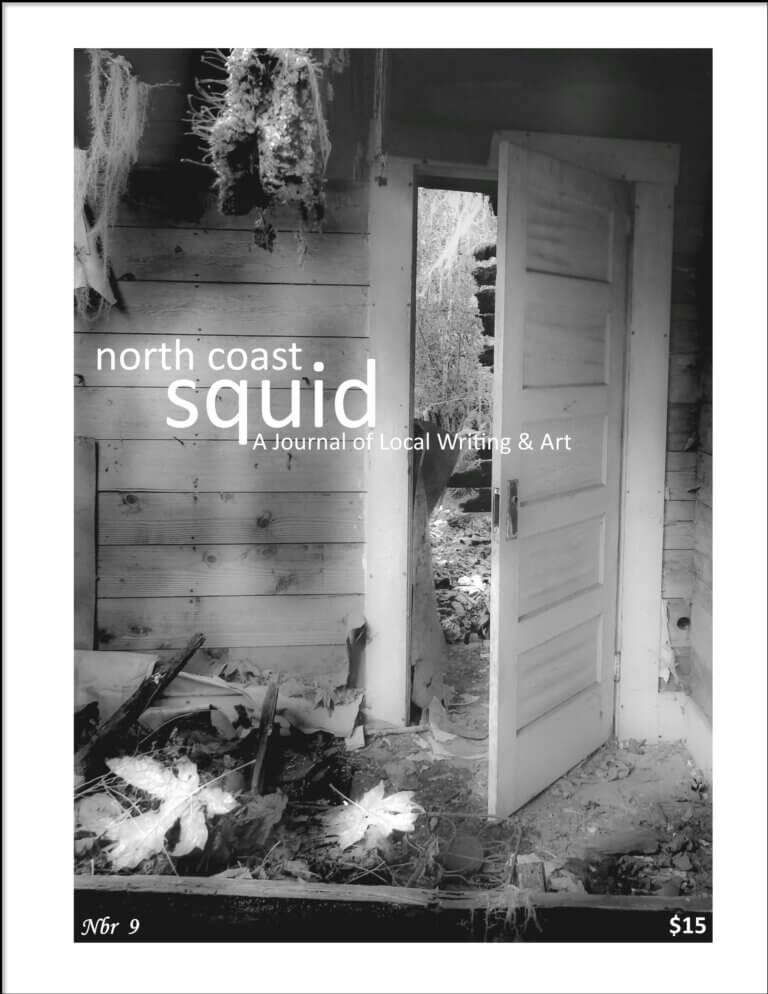
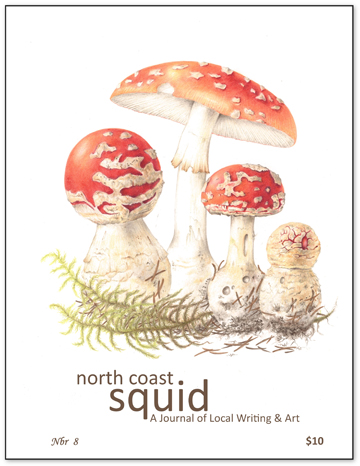
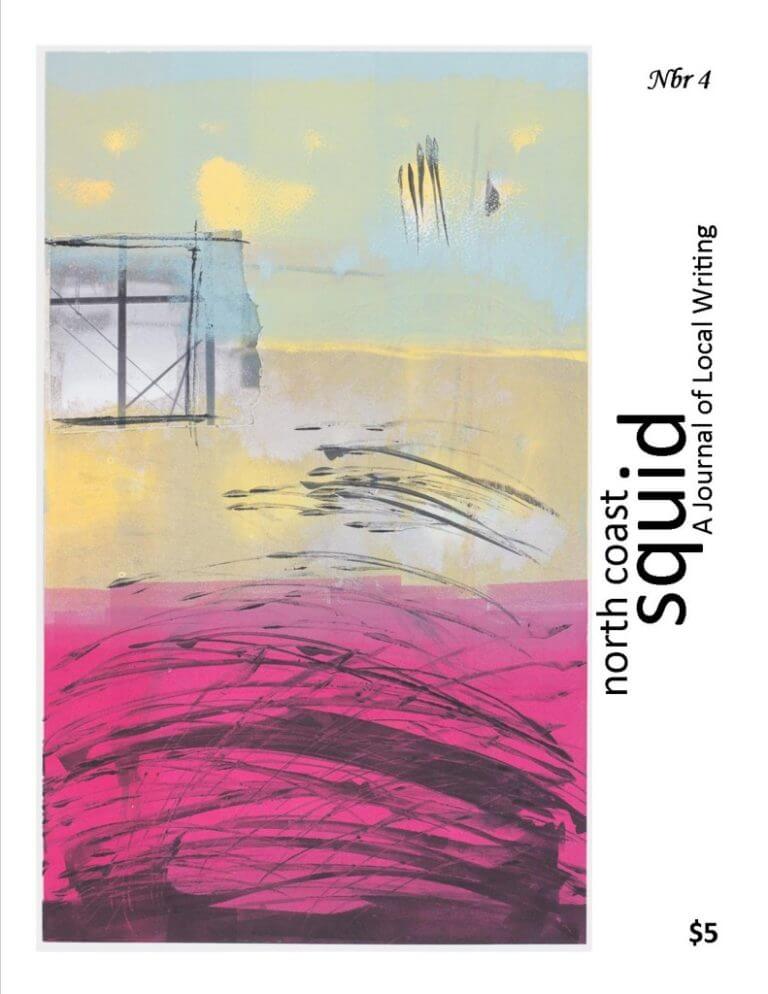
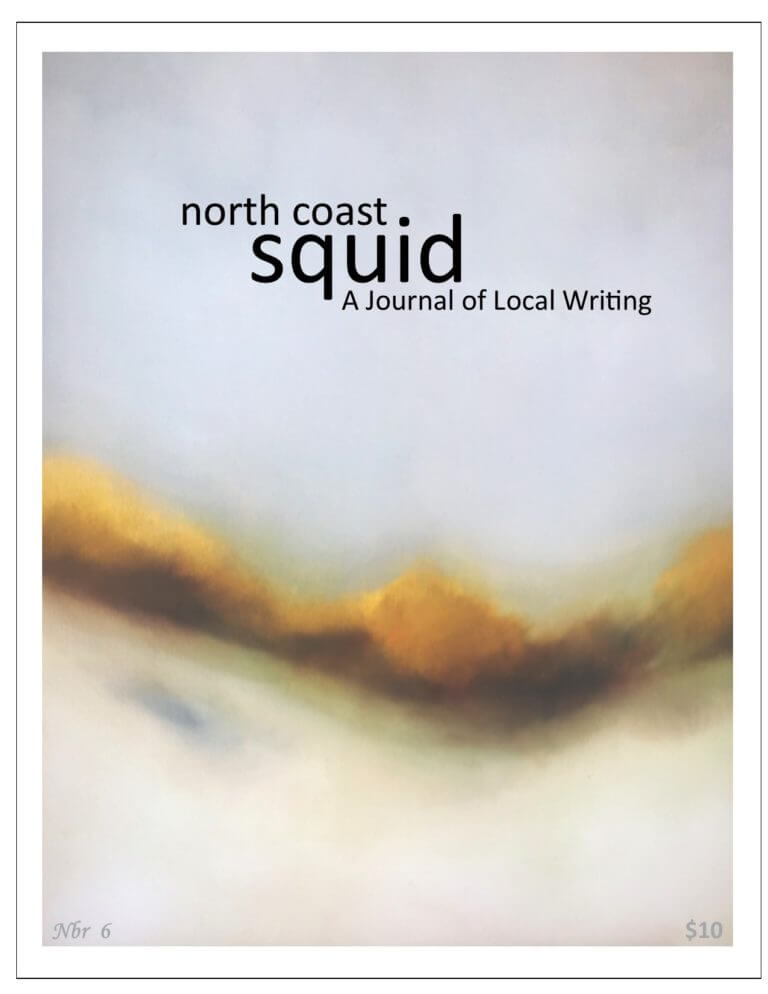
The North Coast Squid, A Journal of Local Writing, was first published in 2012 in collaboration with The North Coast Citizen and is now published by the Hoffman Center for the Arts Writing Program and our dedicated team of volunteers. This full-color literary magazine offers local writers and artists—as well as those who have a strong connection to the north Oregon coast—a way to share their work in print.  We publish the North Coast Squid every other year in odd-numbered years.

The 10th Edition was released in October of 2025 with an opening reception for the exhibition of art in the HCA Gallery on Saturday, October 4th, and a special release party on Sunday, October 5th, at the Pine Grove Community House.

Copies are available for purchase in our Gallery, through ordering online, or see “More Information” for local retailers along the North Oregon Coast.

Where Can I Buy The North Coast Squid?
The North Coast Squid can typically be found at select local and regional bookstore and merchant partners.  But get your copies early, as they do sell out. Net proceeds from the cover price go toward the cost of producing future editions.

Manzanita: Hoffman Gallery, Cloud & Leaf Bookstore, Manzanita News & Espresso, Wild Manzanita Grocery & Cafe’
Nehalem: Wild Coast Goods
Wheeler: The Roost
Rockaway Beach: Seaquest Treasures
Tillamook: Tillamook Country Pioneer Museum
Cannon Beach: Cannon Beach Book Company, Cannon Beach Art Gallery
Seaside: Beach Books
Astoria: Salty Siren Bookstore, Godfather’s Books

Or you can purchase a copy online.


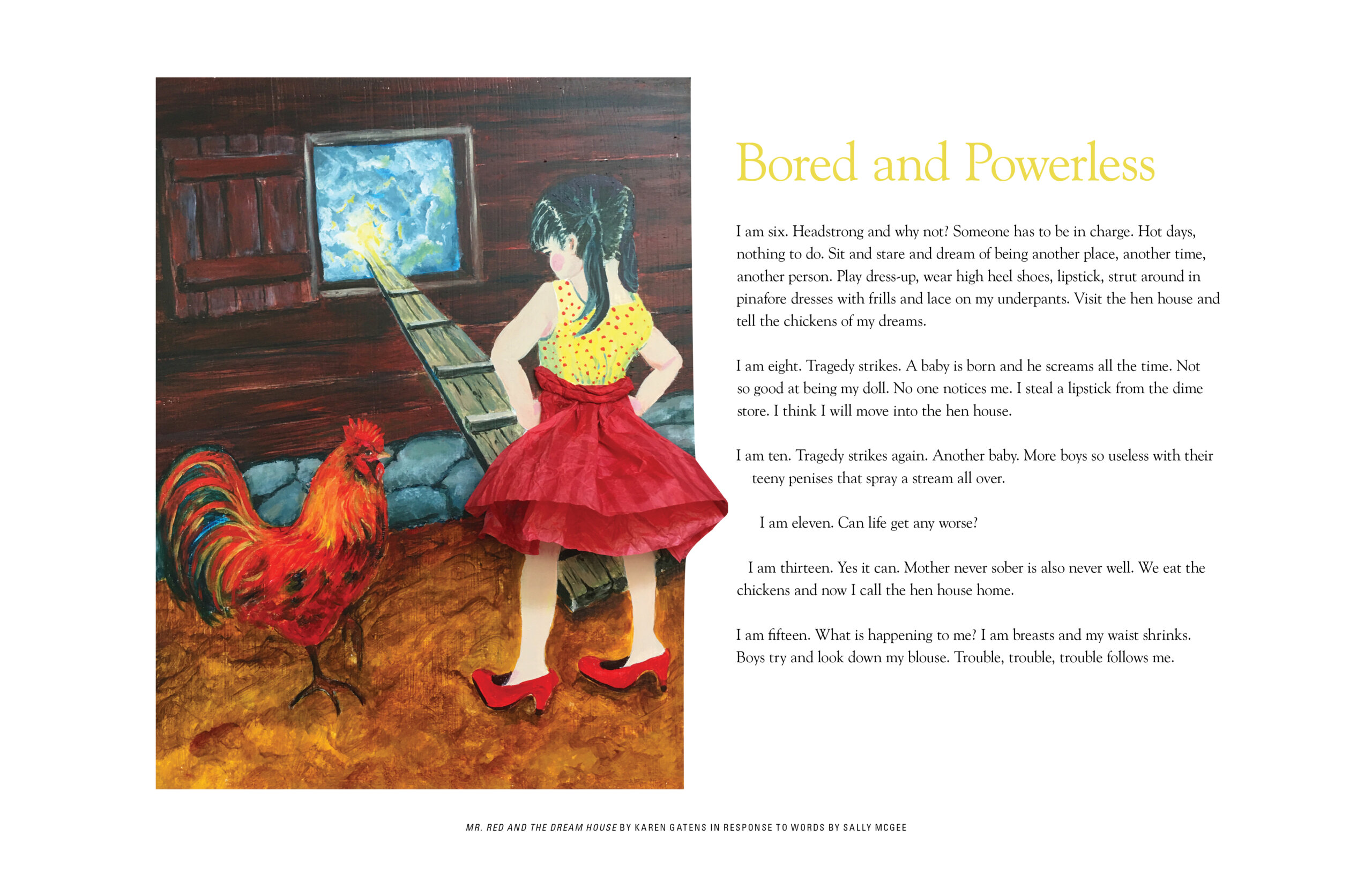
Word & Image

Word & Image takes the Greek tradition of Ekphrasis, which is writing in response to art, and turns the tables to include visual art in response to writing.  The combinations of word and image that are created reveal new layers of meaning and give artists and writers the opportunity to see their art reflected in the work of another’s creative expression.  The result is a set of printed broadsides for each pairing and an exhibition book of the broadsides.  The Word & Image broadsides go on display in the HCA Gallery in the late Autumn, along with the original artwork that is created through this collaboration between paired writers and visual artists.  The corresponding Word & Image exhibition book is published and released in tandem with the opening reception and monthlong exhibition, and is available for purchase through the HCA Gallery.

The Word & Image project is produced in even-numbered years
We seek writing and visual art that is well-crafted in a diversity of mediums and of interesting subject matter when the submission window opens during the month of April in even-numbered years.


Wonder Garden Poetry Post

The Poetry Post displays poems that have received an honorable mention in the annual Neahkahnie Mountain Poetry Prize contest.

May 2026: “Fur Breakfast” by Willa Schneberg

June 2026: “Preparing for Surgery” by Kiersta Fricke-Gostnell

July 2026: “Remission: The First Outpatient Procedure” by Asher Finch

August 2026:  “Eulogy for M. Lagerfeld” by Merridawn Duckler

September 2026: “equinox” by Deborah Akers


Community Writes

“Community Writes” is an annual offering of the Hoffman Center for the Arts, in conjunction with the visual arts Community Show  that is exhibited every January in the Gallery.

Writers with a connection to the North Oregon Coast are invited to submit writing during the open submission window in November/December that focuses on the annual theme for the Community Show. The last several years, the theme has been a specific color. 


Please see our Submittable page for more details on the current theme and dates for the open submission period.

Archive of Submissions